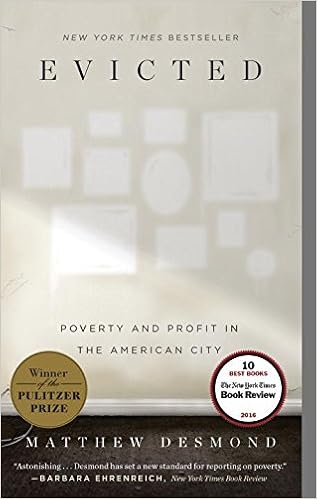
This week, I began reading Evicted, by Matthew Desmond. This non-fiction novel is a
New York Times Bestseller and a winner of the Pulitzer Prize, and for good reason.
Only a few pages into the book, I realized how impactful Desmond’s work was, and
still is today.
New York Times Bestseller and a winner of the Pulitzer Prize, and for good reason.
Only a few pages into the book, I realized how impactful Desmond’s work was, and
still is today.
 In the “Author’s Note”, Desmond states that most of the events took place between
 May 2008 and December 2009. Besides the fact that all of the events recorded took
place in such a short time span, it surprised me how long ago the events occurred
(almost 10 years have passed!). I wondered, have things really changed since then? In
order to answer this question, I did some background research, and the results were truly
heartbreaking.
I learned from Forbes that as of 2015, more than 20 million renters—more than half of
all renters in the U.S.—were cost burdened, meaning they spent at least at least 30% of
their income on rent. That's up from almost 15 million in 2001. And while rents have
risen 66 % since 2000, household incomes have only risen 35%.
all renters in the U.S.—were cost burdened, meaning they spent at least at least 30% of
their income on rent. That's up from almost 15 million in 2001. And while rents have
risen 66 % since 2000, household incomes have only risen 35%.
Yes, these statistics do convey a melancholy tone, but what you don’t see is the families
behind it. Through this novel, Desmond is able to follow 8 different families in Milwaukee
over the course of a year and a half. Not only does Desmond follow the families’ economic
struggles, but also their cultural ones. For example, the novel states that among Milwaukee
renters, 1 in 5 black women report eviction, versus 1 in 15 white women.
What separates this book from others on poverty, however, is how the novel appeals to the
behind it. Through this novel, Desmond is able to follow 8 different families in Milwaukee
over the course of a year and a half. Not only does Desmond follow the families’ economic
struggles, but also their cultural ones. For example, the novel states that among Milwaukee
renters, 1 in 5 black women report eviction, versus 1 in 15 white women.
What separates this book from others on poverty, however, is how the novel appeals to the
public. Instead of listing off statistics, Desmond includes them in the stories he tells. This
is the reason why I find the book particularly heartbreaking. Every few pages, a statistic is
included and you’re forced to remember that everything in the book in true.

is the reason why I find the book particularly heartbreaking. Every few pages, a statistic is
included and you’re forced to remember that everything in the book in true.

Comments
Post a Comment